COVID-19 Pandemic
 burden
🦠 Evidence in a Crisis
Measuring what the pandemic did, explaining it to the public, and informing decisions
📜 Background
COVID-19 caused millions of deaths worldwide and put health systems under extreme and unequal strain, while public debate was shaped by contested messaging and widespread misinformation. Decision-makers, journalists and the public needed rapid, trustworthy evidence on who was being hospitalised, who was dying, and how well vaccines were working. Otavio’s work, largely based in Brazil, one of the hardest-hit countries, addressed these needs and was used by national and international bodies.
🔬 Otavio’s Contribution
- Hospital burden: Led the first nationwide analysis of COVID-19 hospital admissions in Brazil (254,288 patients, February-August 2020), using official public data with openly released analysis code, followed by a comparison of the first and second waves and an analysis of spatial and temporal fluctuations in hospital fatality.
- Vaccine effectiveness: First author of real-world effectiveness studies within the VEBRA COVID-19 consortium, including CoronaVac in older adults and Ad26.COV2.S (Janssen). The full vaccine story is described in our Vaccine Impact profile.
- Public epidemiology: Explained epidemiological evidence, methods and uncertainty on Twitter/X (@otavio_ranzani), in op-eds, interviews and webinars, and created CORONAvito, an educational comic explaining how infection and disease unfold over time (thread, May 2020).
- Trial standards: Panel member of the international consensus defining core outcome measures for COVID-19 trials (respiratory failure, multiorgan failure, shortness of breath and recovery), published in Critical Care Medicine (2021).
- Trial safety: Chaired the Data Safety Monitoring Boards of the STOP-COVID trial (tofacitinib) and of a leronlimab trial that was halted for safety (see Clinical Trials).
🌍 Impact
Informing vaccine policy for older adults
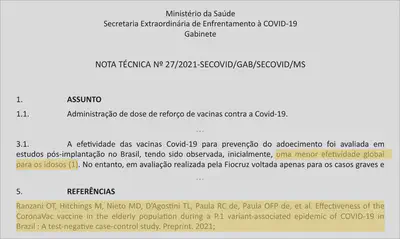
- The CoronaVac study in adults aged 70 and over was shared with Brazil’s Ministry of Health by the study team, and was cited in Technical Note 27/2021 (26 August 2021) as evidence of lower vaccine effectiveness in older adults. That note introduced a booster dose for people aged 70 and over; Technical Note 43/2021 extended it to people aged 60 and over.
- The study was presented to the WHO Strategic Advisory Group of Experts on Immunization (SAGE), and its age-stratified estimates were cited in the SAGE evidence-to-recommendation tables for CoronaVac supporting booster doses for older adults.
- The Ad26.COV2.S (Janssen) effectiveness study was cited in the WHO interim recommendations for the use of the Janssen vaccine (updated 9 December 2021), as evidence that effectiveness against symptomatic disease ranged from 51% to 79%, and in Technical Note 61/2021, in which Brazil’s Ministry of Health set out a second Janssen dose.
Informing legal action on data transparency
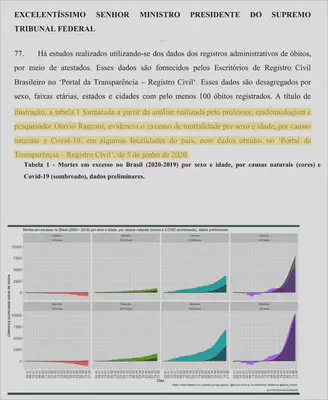
- In June 2020, when the Ministry of Health delayed and reduced its daily COVID-19 data, three political parties asked the Supreme Federal Court to restore it (ADPF 690). The petition reproduced Otavio’s analysis of excess mortality from civil-registry data, first shared on Twitter, as evidence of under-reporting. On 8 June 2020, the Court ordered the Ministry to restore full daily publication of COVID-19 data.
Informing parliamentary scrutiny of unequal harm
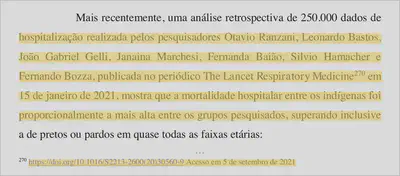
- The nationwide analysis of hospital admissions was cited in the final report of the Federal Senate’s Parliamentary Inquiry into the pandemic (CPI da Pandemia, October 2021) as evidence that in-hospital mortality among Indigenous patients was proportionally the highest of all groups studied.
Strengthening public understanding during misinformation
- The fact-checking agency Aos Fatos used Otavio’s expertise to correct false or misleading claims about the pandemic: that deaths per million showed Brazil’s epidemic was mild (May 2020), that asymptomatic people “transmit antibodies” (July 2020), and that the number of “recovered” indicated success against the pandemic (August 2020).
- Journalists used his analyses in their reporting, including a BBC News Brasil report on mortality among intubated patients in 2020 (March 2021) and coverage of his explanation of how CoronaVac’s efficacy was calculated (January 2021).
- Drawing on his epidemiological expertise, his analyses and explanations of others’ studies were used directly by journalists: Estado de Minas built a report on health-system collapse in Uberlândia and Porto Alegre around his mortality graph (March 2021), and UOL embedded his explanation of a national vaccine-effectiveness study of 61 million people (August 2021).
Wider policy uptake
- The COVID-19 studies were also cited by the European Medicines Agency and ECDC (joint statement on a fourth vaccine dose, 2022), WHO guidance on evaluating vaccine effectiveness (2022) and its weekly epidemiological updates, Africa CDC scientific and public health policy updates (2021-2022), the World Bank (2022, 2023), the Inter-American Development Bank (2025), the Dutch RIVM (2024) and CONASS (2025).
📣 Reach and Engagement
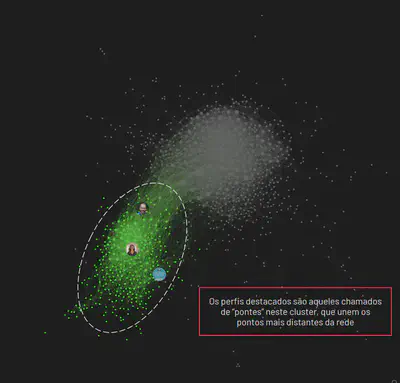
- Independent network analyses of the Brazilian COVID-19 conversation on Twitter by Science Pulse, a tool built with the International Center for Journalists to help journalists find trusted scientific sources (which cited Otavio as an example of the experts it tracks), and IBPAD placed Otavio among the most influential scientists:
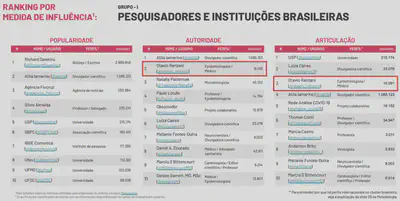
- 2020 (213,469 tweets from 1,200 profiles, June-October): 3rd most influential among Brazilian researchers and institutions, 2nd for authority (centrality in spreading information) and 3rd for articulation (bridging between groups) (report).
- 2021 (450,906 tweets from 1,088 profiles, November 2020-November 2021): among the 15 most influential profiles, 4th for authority and 7th for articulation (Núcleo).
- In these analyses, authority identifies the profiles most central to the spread of information in the network, and therefore the most respected or prestigious sources. Articulation identifies profiles that act as bridges between groups. Popularity is simply the number of followers. The 2020 report noted that Otavio, “although not as popular [by number of followers], holds an important position in terms of authority and articulation in the network”.
- The 2020 ranking was presented at a WHO EPI-WIN session on science communication during the pandemic (2021).
- A later academic study of these five leading voices described Otavio’s communication as more technical than that of general science communicators, consistent with his role as a specialist epidemiologist explaining data, methods and emerging evidence rather than a general-audience influencer (Animus, 2023).
- An international study of COVID-19 vaccine communication on Twitter selected him as one of ten recognised health experts across five countries, as an expert voice for the Portuguese-speaking world (Media and Communication, 2022).
- In 2023, he was a nominee for the international COVID-19 Influencers Social Media Awards, organised by UniteHealth.
- His Twitter/X audience grew from about 3,000 followers (May 2020) to about 40,000 (May 2022).
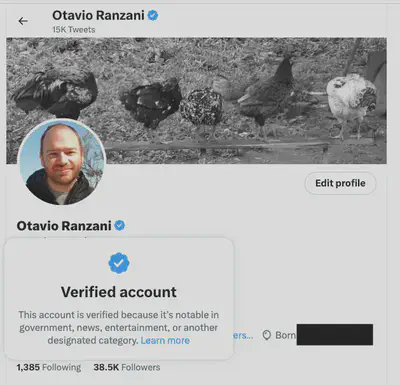
- In 2020, during COVID-19, Twitter verified Otavio’s account as a notable expert voice. This was the platform’s merit-based verification, which was replaced in April 2023 by paid subscription verification.
- In December 2020, Instituto Serrapilheira, a Brazilian science funder that supports Science Pulse, highlighted him as one of the three main Brazilian scientific influencers on COVID-19, alongside Atila Iamarino and Luiza Caires.
- He spoke at public webinars, including those of FAPESP and Instituto Butantan, and Instituto Questão de Ciência, and was interviewed by national and international media.
🧠 Key Insight
Evidence has most value when it reaches decision-makers and the public in time.
📚 Selected References
Ranzani OT*, Bastos LSL*, Gelli JGM, et al. (2021). Characterisation of the first 250 000 hospital admissions for COVID-19 in Brazil: a retrospective analysis of nationwide data. Lancet Respir Med. 9(4):407-418. doi: 10.1016/S2213-2600(20)30560-9.
Bastos LSL, Ranzani OT, Souza TML, et al. (2021). COVID-19 hospital admissions: Brazil’s first and second waves compared. Lancet Respir Med. 9(8):e82-e83. doi: 10.1016/S2213-2600(21)00287-3.
Brizzi A, Whittaker C, Servo LMS, et al. (2022). Spatial and temporal fluctuations in COVID-19 fatality rates in Brazilian hospitals. Nat Med. 28(7):1476-1485. doi: 10.1038/s41591-022-01807-1.
Ranzani OT*, Hitchings MDT*, Dorion M, et al. (2021). Effectiveness of the CoronaVac vaccine in older adults during a gamma variant associated epidemic of covid-19 in Brazil: test negative case-control study. BMJ. 374:n2015. doi: 10.1136/bmj.n2015.